Peptide Solubility: A Practical Lab Guide
· Peptastic Labs
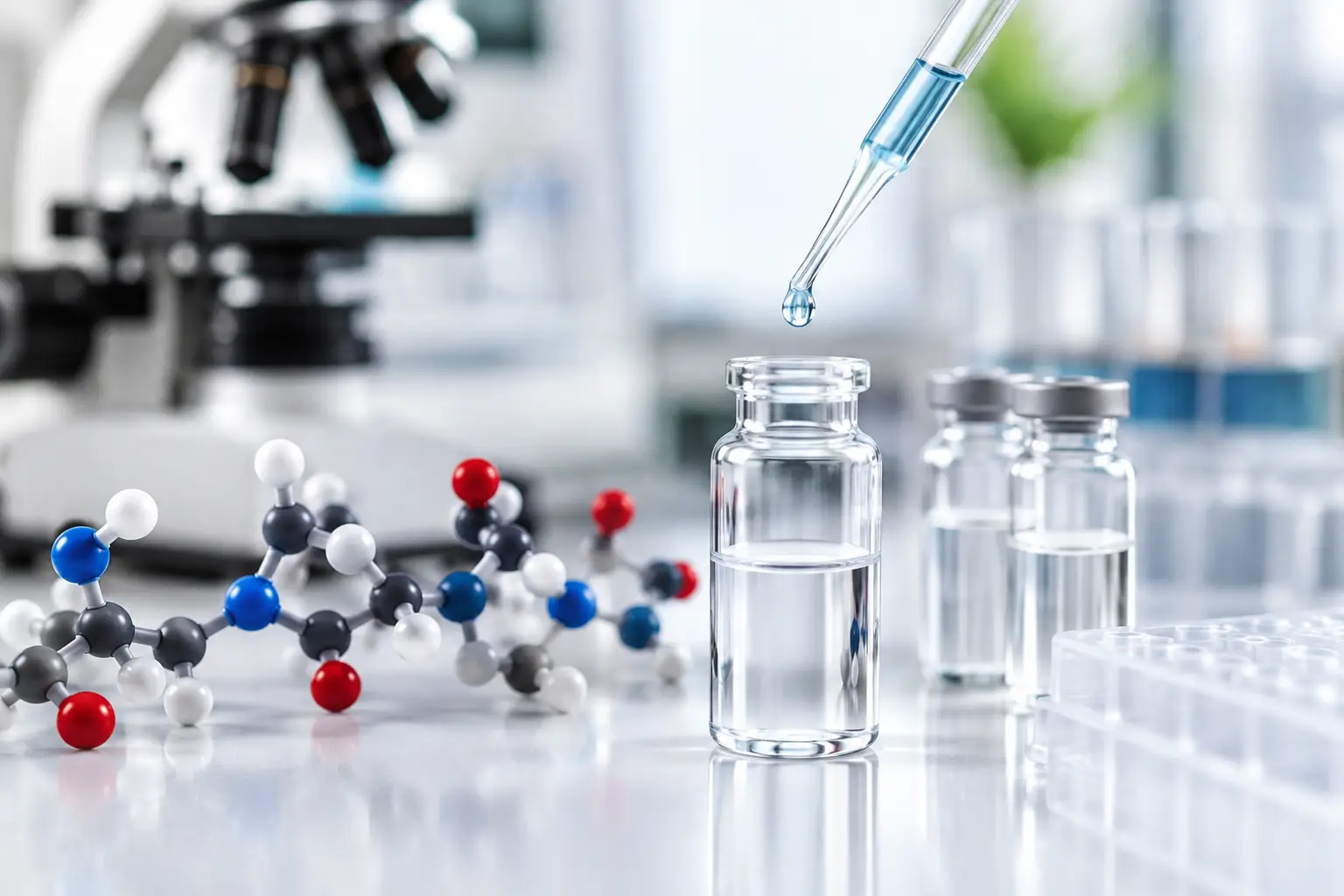
A vial can contain a high-purity peptide and still produce unreliable data if peptide solubility is treated as an afterthought. Cloudiness, visible particles, inconsistent assay response and unexplained loss of activity can all begin at reconstitution. For research teams, solubility is not merely a convenience issue. It determines the concentration that can be tested, the vehicle controls an experiment requires, and whether a nominal dose reflects what is actually present in solution.
Peptides do not follow one universal reconstitution rule. Their behaviour reflects amino-acid sequence, length, net charge, hydrophobicity, counterion, formulation and the final experimental matrix. A documented, sequence-aware approach is therefore more defensible than applying the same solvent to every vial.
What determines peptide solubility?
At a basic level, a peptide dissolves when interactions with the solvent are more favourable than interactions between peptide molecules. Charged residues generally favour aqueous dissolution, while large hydrophobic regions can promote self-association and aggregation. The balance changes with pH because ionisable side chains gain or lose charge as the environment becomes more acidic or alkaline.
A peptide rich in lysine, arginine or histidine may dissolve well in mildly acidic aqueous conditions, depending on the sequence. One containing substantial leucine, isoleucine, valine, phenylalanine or tryptophan content may be more difficult to disperse, particularly at higher concentrations. This is a tendency rather than a guarantee. A short sequence with several hydrophobic residues can behave differently from a longer peptide with the same overall composition because conformation and intermolecular packing also matter.
The isoelectric point is particularly useful. Near its isoelectric point, a peptide has little net charge, so electrostatic repulsion between molecules is reduced. Aggregation and precipitation are often more likely in this range. Moving pH away from that point may improve dissolution, but the chosen pH must remain compatible with downstream cells, enzymes, buffers and analytical methods.
Counterions deserve attention as well. Peptides are commonly supplied as salts, and acetate or trifluoroacetate counterions can influence mass calculations, pH and solution behaviour. Batch documentation should identify the supplied form where available. The stated peptide content, rather than vial weight alone, is the relevant basis for calculating a working concentration.
Peptide solubility starts before the solvent is chosen
Before opening a vial, review the sequence, molecular weight, salt form and batch-specific Certificate of Analysis. A COA confirms important quality attributes such as identity and purity, but it does not establish that a peptide will remain soluble at every concentration, pH or temperature. Solubility must be evaluated under the conditions of the intended study.
Define the required final concentration first. This prevents a common problem: preparing an excessively concentrated stock that is marginally soluble, then assuming subsequent dilution has corrected the issue. If the stock contains aggregates or material adhered to the vial, the dilution may still be chemically inconsistent even when it appears clear.
It is also worth checking the composition of the final assay medium. Proteins, serum, salts and buffer components can either stabilise a peptide or cause precipitation. Phosphate-buffered systems, for example, may be suitable for many studies but should not be assumed compatible with every sequence or concentration. A solvent that produces a clear stock may still fail when introduced into a biological medium.
A practical reconstitution workflow
Use a small-scale screening mindset, especially for a new sequence or an unfamiliar lot. Record the solvent, target concentration, pH where measured, mixing method, temperature, time to dissolution and final visual appearance. That record is more useful than relying on a generic instruction repeated across unrelated peptides.
Begin with an appropriate aqueous vehicle when the peptide is expected to be hydrophilic. Add solvent gradually and mix gently by swirling or careful pipetting. Aggressive vortexing can create foam, introduce surface losses and complicate visual assessment, particularly for amphiphilic peptides. Give the material time to hydrate before deciding it has failed to dissolve.
When aqueous dissolution is poor, the next step depends on the peptide and the assay. A small proportion of an organic co-solvent may assist a hydrophobic peptide, but that choice creates a separate experimental variable. Dimethyl sulfoxide and related solvents can affect cell viability, membrane behaviour, enzyme activity and readouts even at relatively low final concentrations. Every study using a co-solvent needs a matched vehicle control at the same final solvent percentage.
Acidic or basic adjustment can also alter solubility by shifting peptide charge. This should be done conservatively and with an understanding of downstream compatibility. A solution that becomes clear after a large pH shift may be unsuitable for the assay, and extreme pH can affect peptide integrity. The objective is not simply to make the vial look clear. It is to obtain a stable, analytically credible solution that fits the research design.
If visible particulates remain, do not assume they are harmless. They may be undissolved peptide, insoluble contaminants, fibres or precipitate created during mixing. Compare the material with an appropriate blank, inspect the container and document the observation. For critical work, analytical confirmation after reconstitution may be justified rather than relying on appearance alone.
Concentration changes can reveal hidden instability
A peptide can dissolve at a low concentration yet precipitate during stock preparation, freeze-thaw cycles or transfer into culture medium. Conversely, some materials look satisfactory in a concentrated stock but form aggregates once diluted into a salt-rich matrix. Evaluate the concentrations that matter to the experiment, including the stock, intermediate dilution and final exposure concentration.
Where feasible, prepare a small pilot dilution series and inspect it over the actual assay window. If the study runs for several hours or days, an immediate clear solution is not enough evidence of stability. Time, temperature and contact with plastics can all change the effective concentration.
Storage, handling and adsorption losses
Repeated freeze-thaw cycles add avoidable uncertainty. Aliquot a freshly prepared stock into suitable low-dead-volume containers when the study design permits, then store according to the material-specific documentation and validated laboratory practice. Protect light-sensitive material from unnecessary exposure, and avoid leaving peptide solutions at bench temperature longer than required.
Adsorption to tubes, pipette tips and plates is another understated source of loss. This is most relevant for low-concentration work, sticky hydrophobic sequences and long incubation periods. The risk depends on the peptide, plastic type and matrix, so it should be tested rather than assumed. A recovery check using an appropriate analytical method can distinguish true biological inactivity from a delivery problem.
Filtration is not automatically the answer. A filter can remove particulates, but it may also retain peptide through membrane binding or reduce recovery at low concentration. If filtration is necessary for a study, select the membrane deliberately and verify recovery with the actual formulation. Sterility, recovery and chemical integrity are separate questions.
How to troubleshoot poor peptide solubility
When a peptide will not dissolve as expected, change one variable at a time. Altering solvent, pH, concentration, temperature and mixing simultaneously may produce a clear solution without revealing why it worked or whether it is reproducible. A controlled troubleshooting sequence protects both material and data.
First, confirm the calculation and supplied form against the lot-matched documentation. Next, reduce the target concentration and allow additional hydration time. Then assess whether a modest change in pH or a carefully controlled co-solvent is scientifically compatible with the assay. If precipitation occurs only after dilution, focus on the final matrix rather than the initial stock.
For high-value studies, build solubility checks into method development. Record the final vehicle composition, test peptide recovery where possible, include vehicle controls and define an acceptance criterion for visible precipitate or analytical concentration. This is particularly relevant when comparing lots, scaling an assay or interpreting a weak dose-response relationship.
Why documentation still matters
Solubility is sequence- and method-dependent, but the starting material must still be traceable. Research-grade peptides supported by lot-matched Certificates of Analysis, verified purity data and clear product documentation give laboratories a defined basis for method development. They do not remove the need for formulation work, yet they reduce uncertainty about what entered the workflow.
For purchasers sourcing materials for preclinical or analytical research, Peptastic Labs positions documentation and batch traceability alongside direct access to research-use-only compounds. That distinction matters: a well-documented material supports better experimental records, but it is not a product intended for human use.
The most useful solubility record is often a modest one: the exact lot, solvent, concentration, pH, mixing conditions, storage history and observed result. Build that record the first time a peptide enters a programme, and future experiments will start from evidence rather than guesswork.
For research use only. Not for human or veterinary use. Not for consumption. Nothing in this article is medical advice or a recommendation for use in humans or animals.